Essay · 2026-07-18
The Second Life Is Part of the Life
Adaptive reuse is not an act of nostalgia. It is the practical work of carrying civic value, material intelligence, and local identity into another generation.
Old buildings rarely become obsolete all at once. A railroad timetable disappears, a department store closes, an insurance office outgrows its rooms. The use ends before the usefulness does. What remains is not an empty package but a structure full of spent labor: brick fired and laid, timber raised, stone cut, windows ordered to a particular street, and rooms shaped around the public life of a town. The first question of adaptive reuse is therefore not whether a building can be made new. It is whether we can recognize what is still alive in it.
Use is the strongest form of care
Preservation without use is precarious. A roof cannot be kept sound by admiration, and a vacant room does not become safer because a community values its history. Buildings survive when they can again earn maintenance, receive people, and meet a present need. The new use is not a compromise made after preservation. It is the means by which preservation becomes durable.
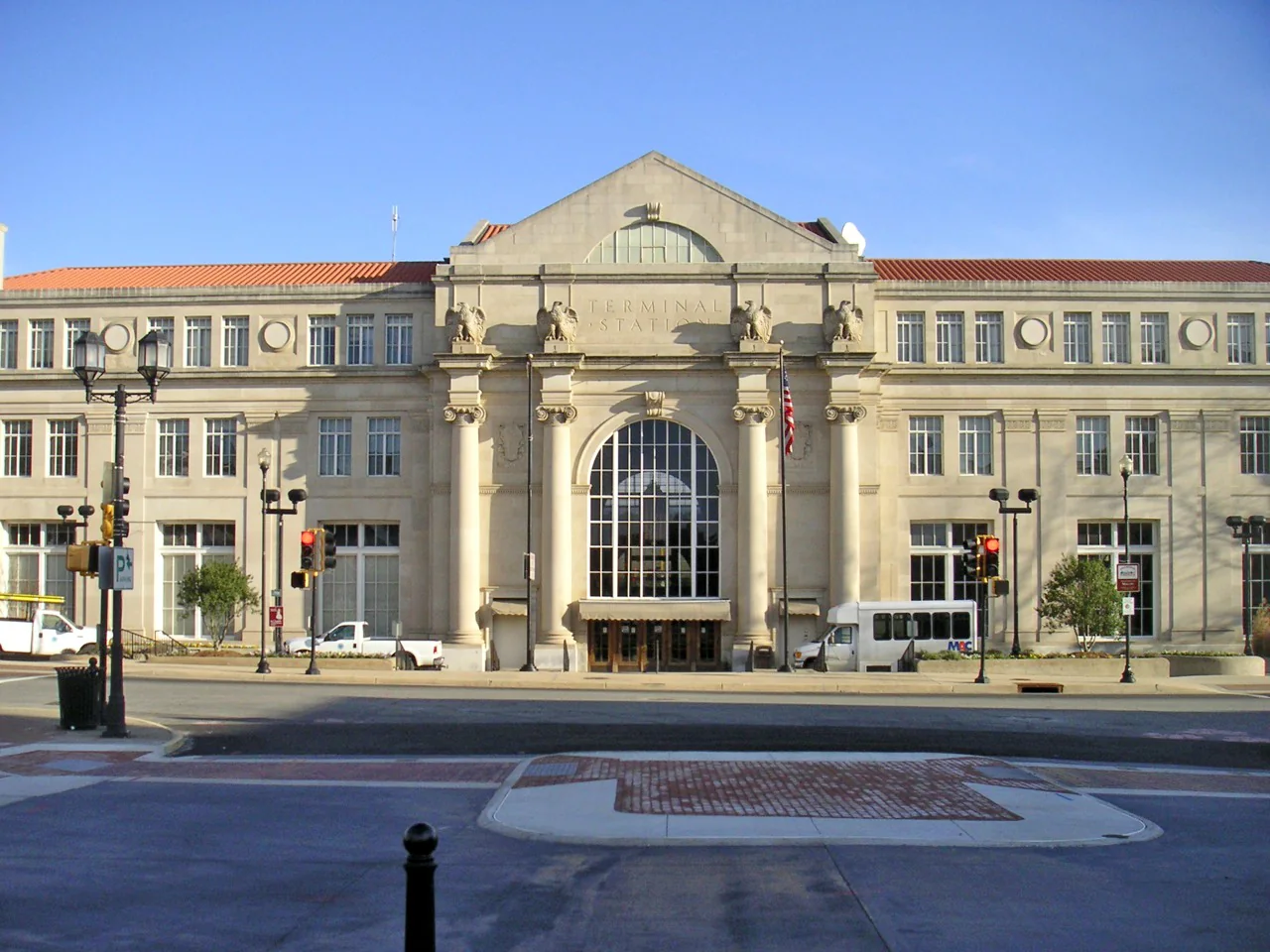
Macon Terminal Station makes the point at civic scale. After years of vacancy, the former rail terminal was rehabilitated as a division headquarters for a Georgia Power Company subsidiary. The work enclosed the open concourse, inserted a rear mezzanine, and converted warehouse areas to offices. Each decision changed the building, as any serious reuse must. Yet the station’s monumental openings, masonry, and long public spaces remained legible. The building did not have to imitate its railroad years to retain their measure. Its second use kept the spatial order available to the city instead of reducing that order to a facade.
That distinction matters. A preserved shell with an indifferent interior can turn history into scenery. A good reuse allows the former building to set terms for the new one. Ceiling height may suggest where gathering belongs. A structural bay may establish the cadence of rooms. An old loading route may become circulation rather than an inconvenience to erase. The architect listens for capacities before drawing additions.
Difference can become an asset
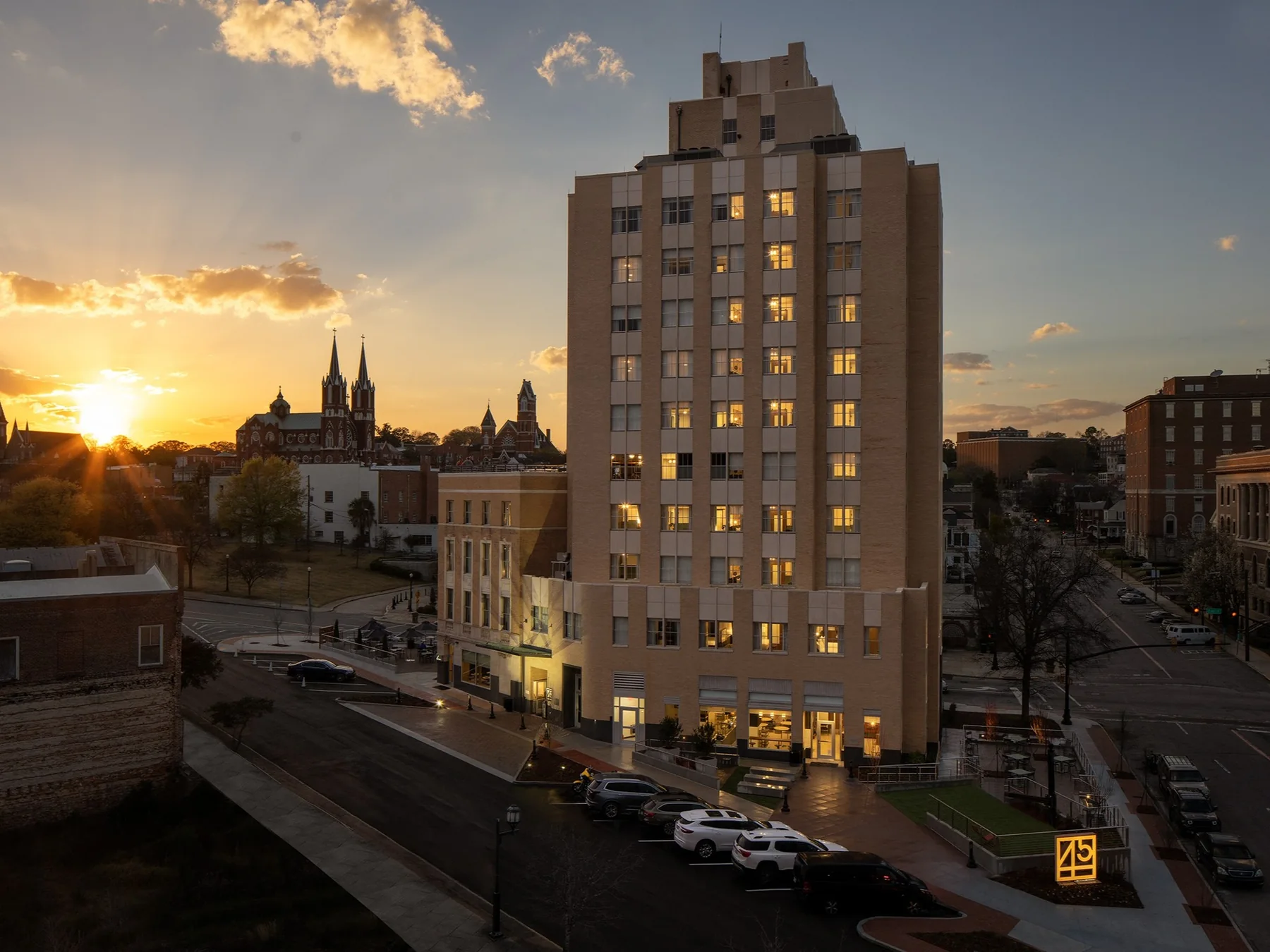
Hotel Forty Five occupies the 45-degree meeting of Cherry Street, First Street, and Cotton Avenue in downtown Macon. Its complex joins a four-story 1923 building to an eleven-story addition designed by W. Elliott Dunwody Jr. beginning in 1939. The hotel conversion had to reconcile differing floor elevations while fitting 94 guest rooms, meeting areas, dining, fitness space, and a rooftop bar into 69,000 square feet. Those facts describe more than technical difficulty. They describe why the finished place could never be a generic hotel dropped onto a generic site.
Original terrazzo, marble, elevator lobbies, and golden brick give the hotel an identity that a new palette would have needed to manufacture. The irregular intersection gives the building its name. The mismatched structures create constraints, but also particular rooms, views, and sequences. Adaptive reuse begins to pay its cultural dividend when the stubborn facts of an existing building become the character of its next life.
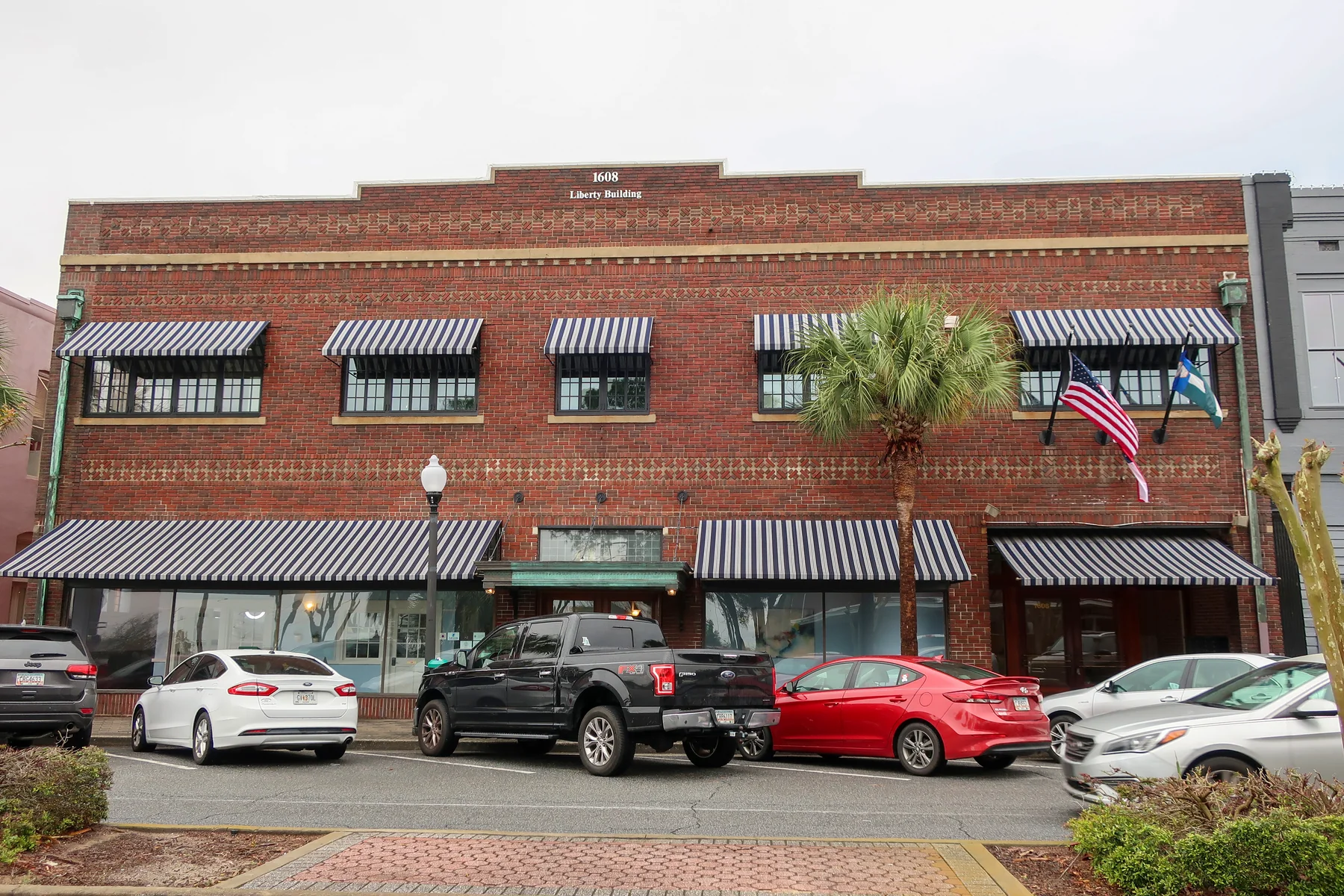
The same principle appears at a smaller scale in Brunswick’s Liberty Lofts. The Liberty Building was constructed in 1925 as a Ford showroom and garage. Its second floor now contains ten apartments, while the original two-story concrete car ramp remains. Keeping that ramp required life-safety work to be integrated around it. Removing it would have simplified one drawing problem and erased the clearest account of how the building once worked. Its presence makes the former garage intelligible without a plaque.
A building can repair more than itself
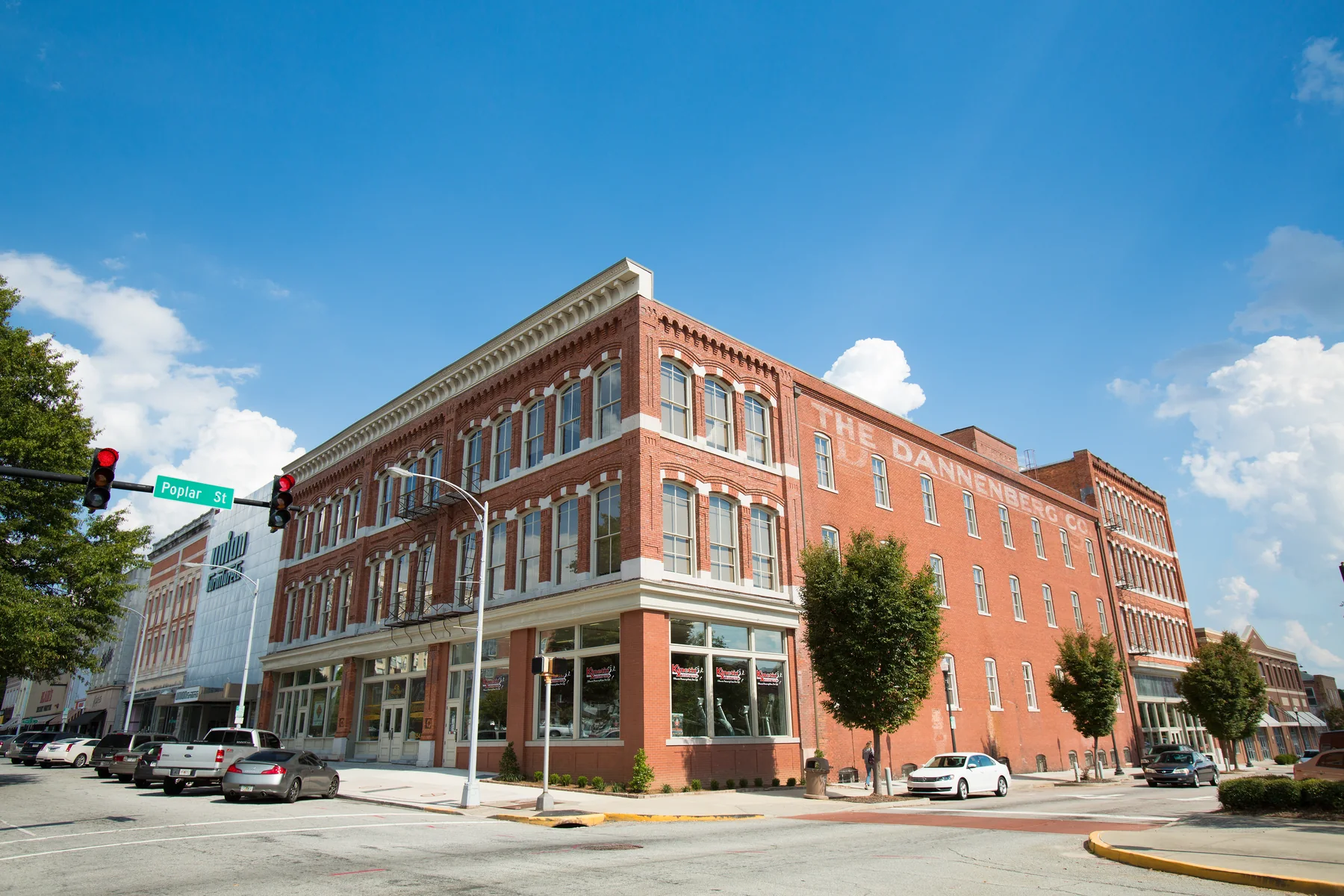
Reuse also changes the life around a building. The Dannenberg Building grew through several campaigns into a three- and four-story downtown complex. Its rehabilitation placed 69 lofts around a new central atrium and returned about 15,000 square feet to street-level retail. Refurbished windows, repointed brick, reopened lightwells, and responsive storefronts repaired the exterior, but occupation completed the work. Residents arrive at night. Shops address the sidewalk. Windows are lit again. The project restored an exchange between building and street.
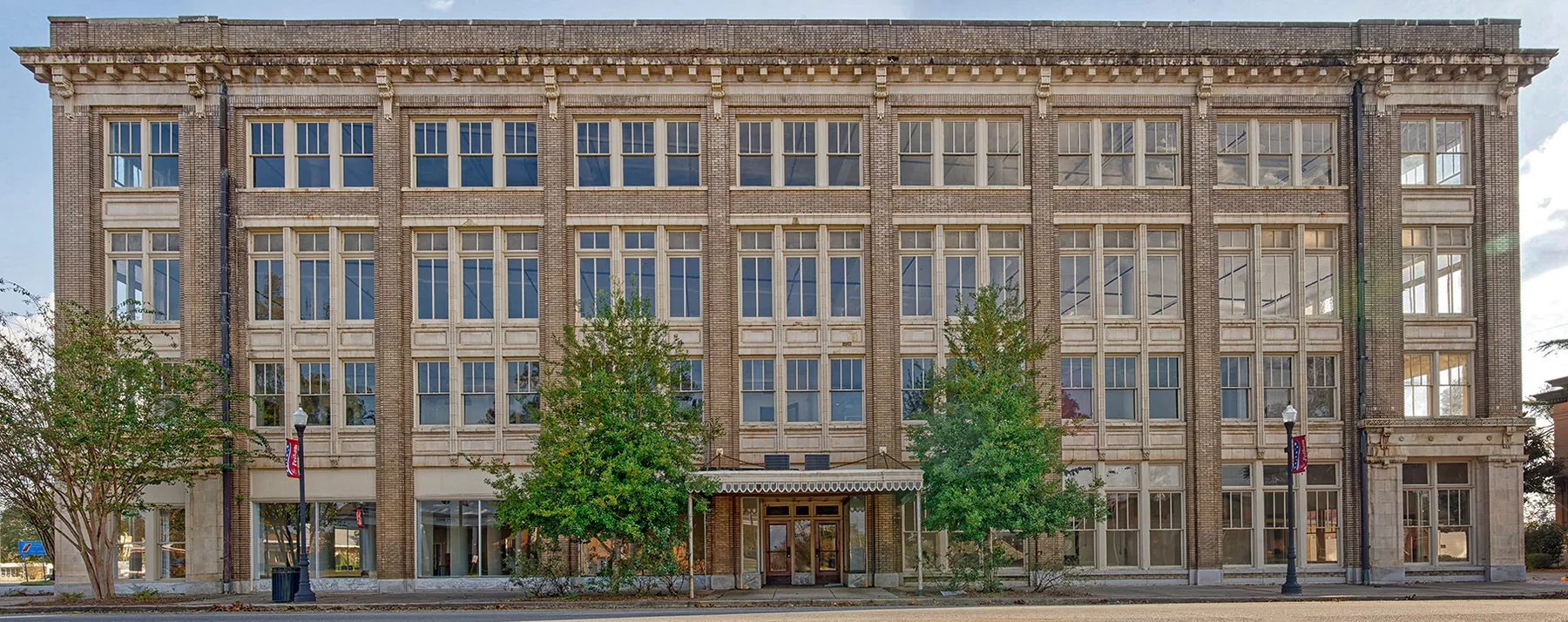
In Pelham, the 52,000-square-foot Hand Trading Company Building once operated as a large department store. Its 2019 redevelopment used historic tax credits to create 54 mixed-income apartments with ground-floor retail. In-place window restoration and the documentation and recreation of its domed ceiling mural carried significant features forward, while housing gave the landmark a daily constituency. A building that served commerce across South Georgia now serves households and the downtown they inhabit.
These projects show why the arithmetic of reuse is larger than a construction budget. Existing buildings hold embodied material, but they also hold addresses, habits, and recognition. Their renewal can support housing, hospitality, work, and local business without asking a town to surrender the physical evidence of how it became itself. Historic tax credits help make that equation possible, but incentives alone do not choose well. The design must distinguish between what is merely old and what gives the place meaning.
Continuity is an active choice
We do not preserve every alteration or freeze a building at an ideal date. Reuse requires judgment: what must remain, what can change, and what new work should be plainly of its own time. Accessibility, fire protection, mechanical systems, structure, and contemporary programs are not intrusions into an otherwise complete artifact. They are the obligations that allow the artifact to keep participating in public life.
That is why an old building deserves more than sentiment and more than automatic defense. It deserves a disciplined reading. Terminal Station asked whether a monumental concourse could support work. Hotel Forty Five asked whether two misaligned buildings could welcome travelers. Dannenberg and Hand Trading asked whether department-store scale could make housing and street life. Liberty asked whether an automobile ramp could remain useful as evidence. In each case, the second life did not cancel the first. It made the whole life of the building longer, stranger, and more valuable.
Buildings in this note
Read the project records
Historic Preservation · Adaptive Reuse
Macon Terminal Station
Macon, Georgia
Adaptive Reuse · Hospitality
Hotel Forty Five
Macon, Georgia
Historic Preservation · Mixed Use
Dannenberg Lofts
Macon, Georgia
Historic Preservation · Multifamily
Liberty Lofts
Brunswick, Georgia
Historic Preservation · Multifamily · Mixed Use
The Hand Trading Company
Pelham, Georgia